

Does your business have a website primarily to generate new leads?
Then you should be concerned about being found on search engines like Google by people who are searching for your products and services. It’s fair to say that those websites that appear on the first page of Google for specific search terms (i.e. your products and services) will take the lion’s share of the clicks.
So how can you appear on the ‘first page of Google?’:
There are really only two ways for your website to come up on the first page of Google’s search results:
1) To land organically i.e. primarily down the centre of the page
2) Paid search marketing – this is normally the couple of lines along the top and those down the right hand side of the page.
The green dotted lines in the image below indicate where these adverts appear in your search engine.
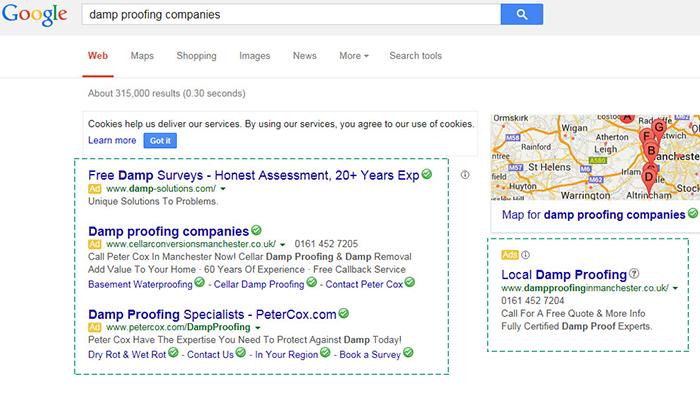
If your website does appear in the page 1 organic results for all your different products/services then you are either in an exceptionally niche industry with little competition or you have invested a significant amount of time/money in making your website the best possible in the eyes of Google search calculation – through an activity traditionally know as Search Engine Optimisation (SEO).
Perhaps it’s obvious but you should be aware that if someone searches for your exact business name on a search engine then you would expect to appear on the first page of results, and likely very close to the top. However, these searchers will be people who already know your business and perhaps wish to check out your contact details and/or your credibility for providing them with your products and services.
So unless, your website regularly receives new visitors from Google’s organic search then you should be considering the paid search marketing commonly known as Google Adwords Pay Per Click (PPC). Adwords is unique in that it can deliver immediate results. Properly setup and managed ads will appear on the first page of the search results page pretty quickly. Compare this to your efforts to rank organically on page one of the search results, which will take much longer, if ever for some businesses!
Okay, so let’s just ensure it’s clear what form of digital marketing we’re talking about here. Adwords is Google’s platform for paid search marketing and paid search (pay-per-click or PPC) are ads placed in search engines. The ads appear on the search engine results page above and to the right of the organic web listings. These ads link to one of your website pages and when a searcher clicks on your ad, they’re directed to the corresponding page.You then pay for the pleasure of the click at a cost based on the competitive value of the keyword phrase the searcher typed into Google. There’s obviously a lot more to Adwords that we can cover here but our objective is to give you a flavour of the basics so that you can start to determine whether it’s right for your business.

Google records every single search word or phrase that is typed into their search engine. Furthermore, they provide tools for you to report the volumes of search for particular keywords, in a particular area and language. Each of these keywords has an average ‘auction’ cost, should they be included behind an Ad that you would want to be placed on the first page of Google. The Ad should be written to appeal to the searchers problem, provide your credibility for providing services and possibly give an idea of the regions you operate in. Assuming your ad is clicked on then the searcher would be taken to a page of your website and your account will be debited by the particular ‘auction cost’ of that click.
As an example, you are a relatively new Damp Proofing company trying to attract customers who want a free survey of their property and you’ve set up an Adwords campaign. Now put yourself in the position of a potential customer who has a damp problem in their house….
You don’t know of any damp proofing companies, so instead of going to the outdated Yellow Pages, you jump onto a computer and carry out a search for “Damp Proofing Companies”. This is one of the keyword phrases that’s been placed in the Adwords campaign, so the ad shows somewhere on the first page. The Ad is the only one that’s offering a free survey so it appeals to your requirements and you click on it. You are then taken to a webpage that clearly explains why you need a survey, the different ways to make contact with the company and it even gives you 10% off any remedial works. So why wouldn’t you decide to call the company? When you do, the Damp Proofing Company has a new lead.
I mentioned the Google Keyword Planning Tool earlier for researching keywords, well the same program can help you determine, the amount of clicks you could expect from a given list of keywords at a specific daily or monthly budget. This means you pretty much have all the information at your fingertips to be able to formulate a marketing plan around Google Adwords.
So getting back to the main question whether it’s right for your business? Well it’s certainly a powerful way of getting your business in front of would-be customers but there are many other factors to bear in mind that we will be covering in future posts such as:
– How competitive the keywords that are relevant to your business are
– The cost of PPC bids for various keywords
– Whether your business is local, regional or national
– The type and cost of product or service you market
– How many leads you need to either maintain or expand your business
– How much time you can budget to the PPC and SEO administrative tasks
– Do you outsource and who can you trust to help you deliver
So in the meantime, we’d be pleased to hear from you about your experiences with Adwords – is it right for your business?